A drop in Google Discover traffic is one of the things we get asked about most. Google’s forums and blogs are full of it, and the answers you find are almost always the same, large images, E-E-A-T and consistent publishing, advice that is often correct and just as often generic. The truth about Discover is that one plus one never quite makes two.
In most cases Discover traffic recovers. SEO techniques alone are not enough, though, because the collapse almost always starts elsewhere, and you only grow back by truly understanding why it happened.
What Discover is, and why it changed in 2026
Discover and search are two different worlds. In search, a user asks a question and Google tries to answer, with keywords, intent and a logic SEO knows well. Discover works the opposite way, because it is a feed that anticipates a person’s interests before they search for anything. In place of the query there is a habit, and habits follow different rules.
Over the past months, with the updates between January and February 2026, this nature has intensified. The recommendation model looks more and more like a social network, with fewer signals from traditional SEO and far more weight on entertainment, consumption habits and the way people react to content over time. In practice, staying on Discover takes more than optimizing a page. You need to know your audience, its habits and the way it consumes content, and that is why classic SEO technicalities matter less here than people think. Discover calls for editorial SEO, a craft different from generalist SEO.
Our daily surveys confirm this direction. The feed rewards real engagement, which users also express through explicit actions like the Follow button or a like on a piece of content, and it penalizes just as clearly when a reader decides to block or avoid a source.
August 2026: readers will say what they want in the feed
On 21 August Google announced what looks like the final piece of this transition, and it is worth pausing on, because it changes how a publisher gets into the feed.
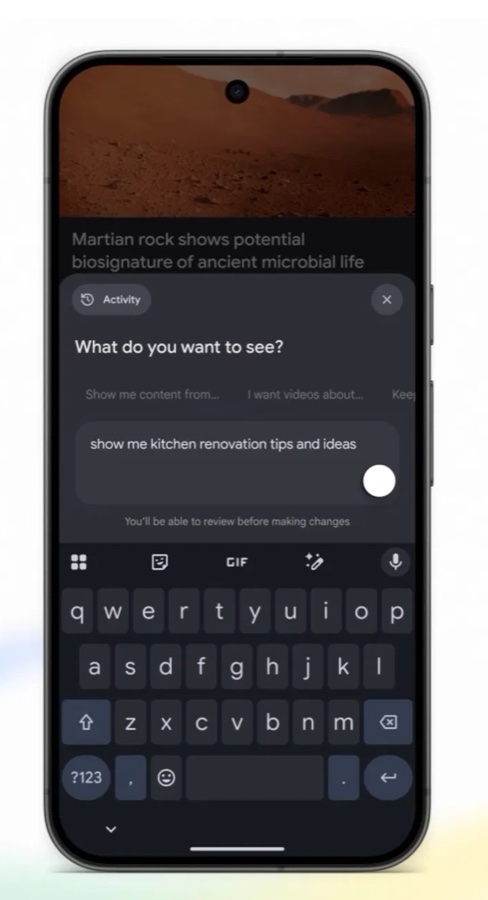
Over the coming days, inside the Google app, users will be able to write in their own words what they want to see more often in Discover and what they would rather see less of. It opens from the three-dot menu next to content, in an interface much like a chat, where the request can get quite specific: the examples Google shows range from kitchen renovation ideas limited to sustainable solutions to weekend travel videos with no camping content.
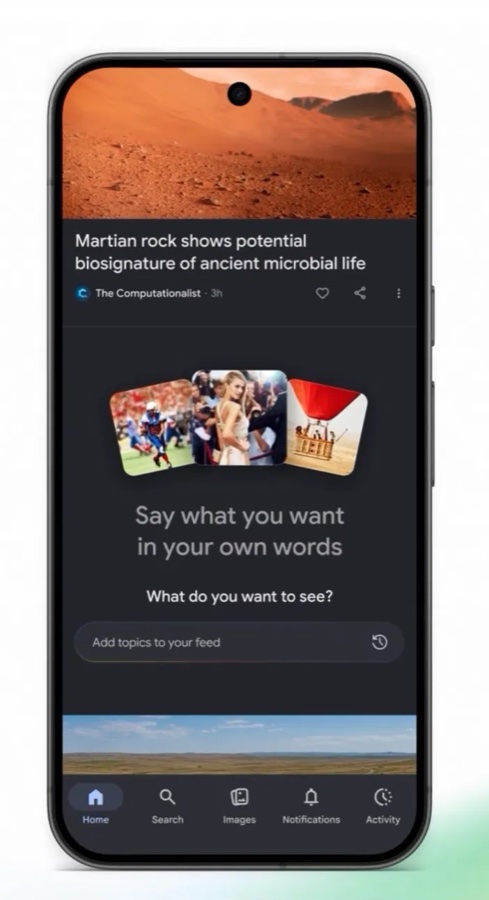
AI interprets the request and returns a summary of what it understood, indicating which kinds of content will be favoured. If the result is not right, further instructions can be added before applying the changes, then a refresh command puts the preferences into effect. Those requests are stored and keep shaping what the user sees afterwards.
Teaching readers to choose you
The same announcement carries a message to publishers that goes beyond the single feature. Google encourages embedding an interactive button in your pages, which means asking the reader for a deliberate gesture: pressing it marks that site as a source they want to find again, without leaving the article they are reading, and from that point its content can appear more often in Top Stories, AI Overviews and AI Mode.
These are two distinct actions and it pays to keep them apart. Marking a preferred source acts on Search, on Top Stories and on generative answers, while on the Discover feed the reader’s explicit action is the Follow. The thread joining them is the same: users declare who they want to read, and publishers need to be in a position to ask them.
This is where the craft shifts. For years the work was making content appealing to an algorithm, and now it also involves prompting a conscious choice from the reader.
Publishers working with us on Blockcraft already have this covered: our editorial CMS has long included the buttons for being marked as a preferred source and for being followed on Discover, because the direction had been legible for months before it reached Google’s guidelines.
That those gestures really count is shown by the figure Google released: users have already selected more than 600,000 unique sources. The documentation for integrating the button is public, so for anyone starting now it is a short development task with a return that compounds over time.
The other significant change concerns Google News audio briefings on Android: users will choose the topics in their own daily digest, with sources credited and links to the full articles. The Discover personalisation rollout starts in the coming days, and Google has not detailed the countries and languages in the first phase.
What it means for anyone who has lost traffic
Look at the sequence of recent months and the direction is legible: first interactions with content, then the Follow button, then preferred sources on Google News, and now the ability to state your interests in words.
Discover is becoming less a place where you intercept an algorithm and more a place where you get chosen by a reader. Technically that changes a great deal, while strategically it confirms what we have been telling the publishers we work with for some time: traffic cannot be the only measure of an editorial project’s value. If millions of visits arrive because an algorithm distributed a piece, and almost none of those readers could name who published it, the problem exists before any drop. It gets bigger when the business model depends almost entirely on that one channel.
There is a question that from today works as a metric: if tomorrow morning Google asked your readers which titles they want in their feed, how many would write your name?
Discover changes constantly, and this is why we measure it
This is also why we built our own observatory. Discover moves at a frequency search does not know, and what works today may not hold two weeks from now. Measuring it every day is the only way to tell an ordinary swing from a real problem, and to avoid chasing shadows. Our surveys show regular shocks even when no update is declared on Google’s official page, and by now it is physiological: the Discover feed keeps learning on its own, and that translates into constant adjustments.
And we do not only watch Italy. We constantly monitor international markets, starting with the United States, which on Discover phenomena and AI search is often months ahead, and comparing what happens elsewhere with what happens here gives us a forward-looking view, the kind that lets us see the waves coming before they reach Italian sites.
Sequel Index
Real-time volatility of Google Discover traffic from our observatory.
If the reading is high, the market is turbulent and many sites are swinging together, so in all likelihood you are not alone. If it is low while your traffic falls instead, the signal is clear, because the cause almost certainly sits in your own house and has to be looked for in the site’s history.
Why a drop is almost never where you look for it
When traffic collapses, the first instinct is to look for the cause in the content or the technical details. The official guidelines suggest images at least 1200 pixels wide and other technical requirements to meet, but focusing only on those is the fastest way to keep missing where the problem really lives.
This is why the checks in our Google Discover consulting go beyond technical parameters. On every site we conduct a complete assessment, from the technical side to the editorial strategy down to the newsroom’s daily routine, because in most of the cases we have handled the reasons for a collapse live exactly there, in how the platform has learned to perceive the site over time. Discover does not judge the single page, it judges the source, and trust in a source is built or lost over time, never overnight.
That is because a piece of content travels through several stages inside Discover: eligibility first, then access to the feed, then the possible distribution spikes, and every stage has its own requirements. Understanding why some content works and some does not is the foundation, and the answer can sit in the content itself, in the format, or in what the surrounding market is determining.
It is also why clickbait has a short life. Spikes built on viral headlines produce a strong, immediate impact with little substance, because the feed stops trusting that kind of content, which ends up working against the very system that was supposed to reward it.
This changes the kind of work required, because you need to understand where and why the site stopped being relevant, and that is done by crossing signals traditional SEO often does not identify. The work then becomes a method the newsroom consolidates over time, made of tools to monitor what happens day by day and the ability to read that data before a dip becomes a collapse.
The analysis has to hold several planes together, the technical one, the editorial one and a market context we now know well. And part of the job is passing on to newsrooms the sensitivity to understand what is happening and why. When the newsroom starts working in that direction, technical blocks get identified and best practices become habits, and the result shows.
What happens without a method, and what happens with one
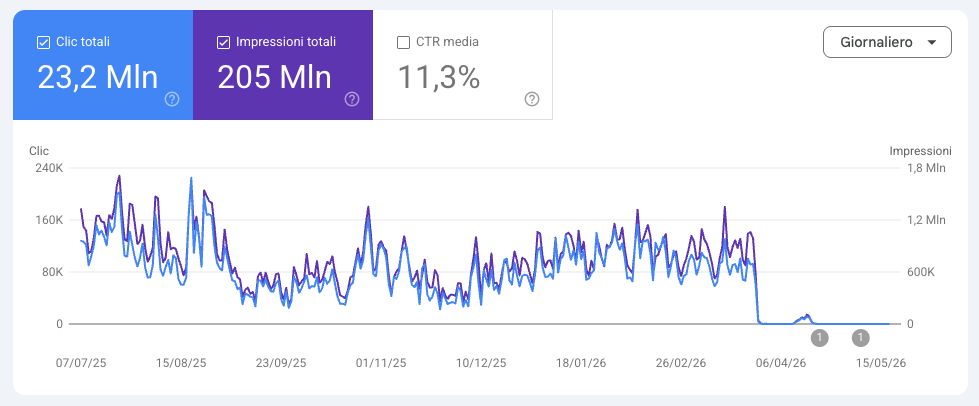
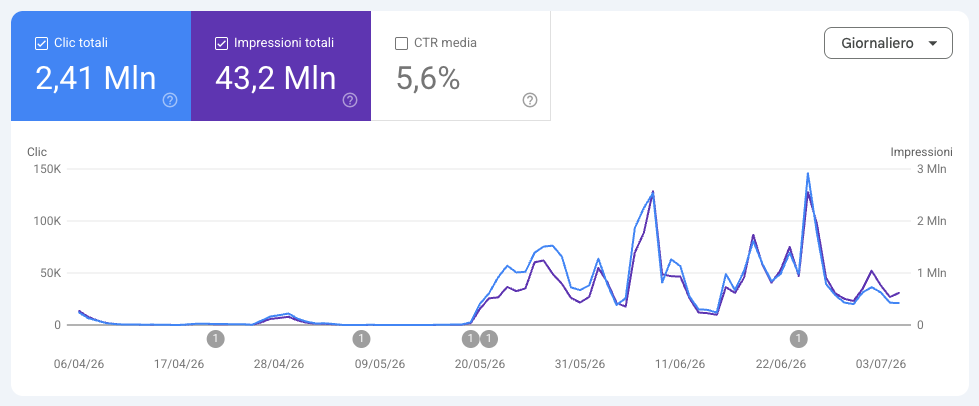
The first chart tells the story we see most often, that of a site pulling big numbers on Discover that collapses when it stops meeting the platform’s requirements without noticing. What brings it down is almost always a slow erosion nobody was measuring, rather than a single error.
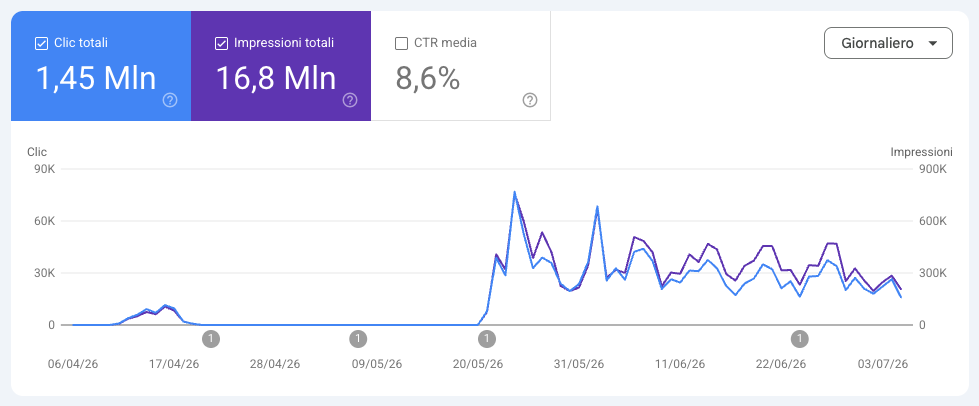
The second is the result of a site where we worked on several fronts, on the technical side on one hand and on the editorial strategy on the other, supporting the newsroom with guidance and training. Traffic grows back and, above all, holds.
Technology matters, and this is why we built Blockcraft
Part of resilience on Discover is played on the technical foundations, from speed and stability to Core Web Vitals and the way images and formats are served. These are the signals the platform reads to decide whether an experience deserves to be pushed, and it is one of the reasons we developed Blockcraft, our CMS, designed so that every piece of content starts with a technical advantage instead of chasing it afterwards. Editorial work remains the heart of the job, but excellent content on slow foundations starts crippled and rarely makes up the gap.
The good news: it recovers, with patience and method
If one plus one does not make two, the flip side is positive too: a collapse may well not be a life sentence. It does take patience and discipline, though, because just as a collapse almost never comes from a single article, a recovery is never built overnight, and the real work is becoming resilient. We have handled many recoveries from Discover drops and the thread that ties them together is always the same, a clear method and the consistency to apply it, because without having understood the real cause you risk working for weeks in the wrong direction.
The key that switches traffic on and off does not exist. What does exist is the ability to read the market beyond your own chart, to find the real cause in the site’s history and to build, over time, the conditions for the platform to trust the source again. That takes a method and it takes time, and on both, when it counts, we are there.
Frequently asked questions